
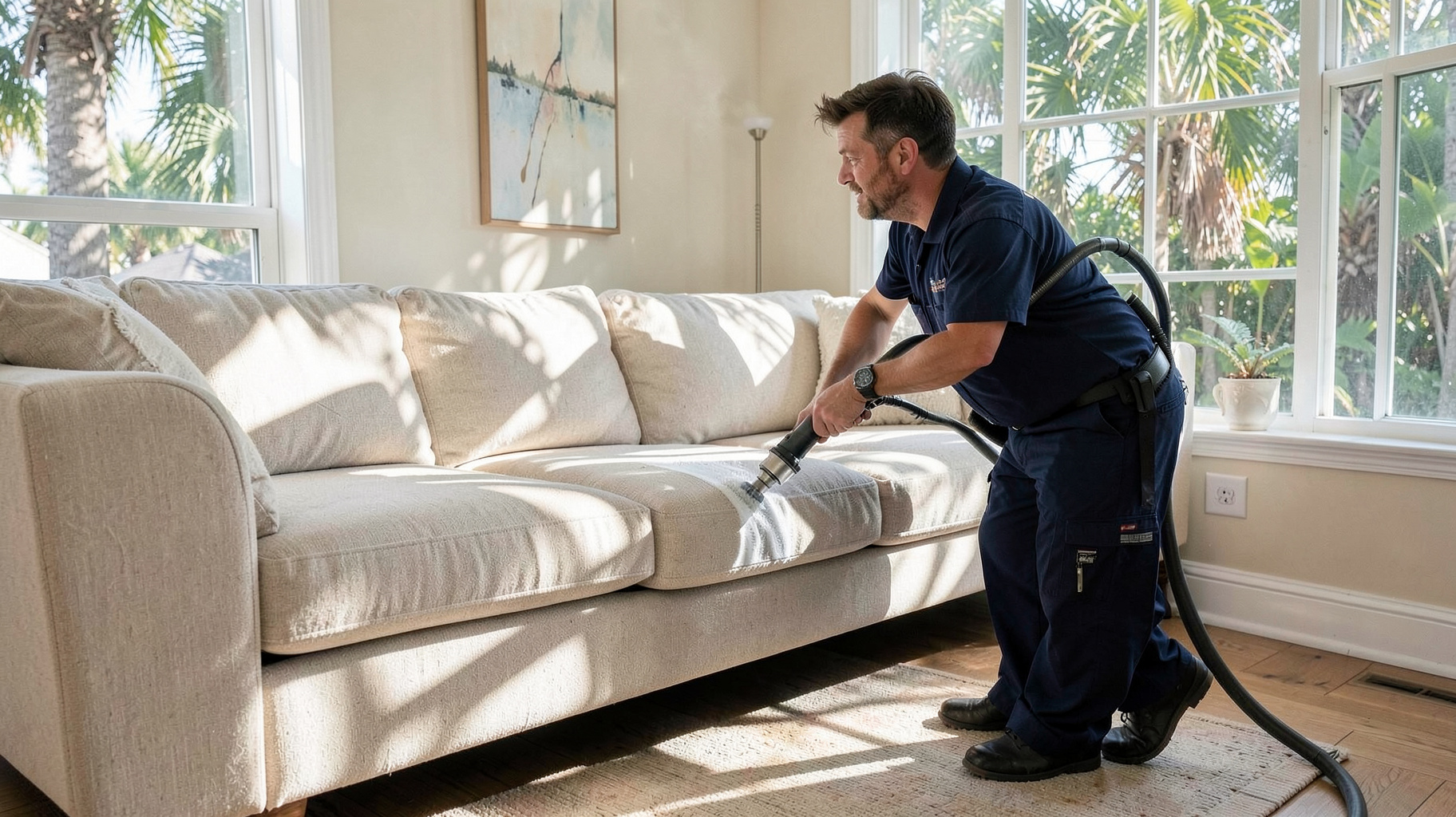
Upholstery cleaning in Bradenton: why your couch holds more than you think
Most Bradenton homes have carpet that gets vacuumed and a couch that gets nothing. Maybe a lint roller if company is coming over. The carpet gets a professional cleaning once in a while; the sofa goes years without one.
That’s a strange split when you think about where people actually sit. Nobody’s lying face-down on the carpet during a Netflix marathon. The couch takes sweat, skin oils, pet hair, spilled drinks, and whatever blows in the door on a beach day, and it holds all of it in fabric the vacuum only skims the surface of.
If your sofa smells faintly musty in September, or the cushions feel slightly damp in a way you can’t explain, the coastal climate is doing exactly what it does to everything fabric here. This post covers what ends up inside upholstered furniture in this part of Florida, why it’s different from inland homes, and when a professional clean actually earns its price.
What Florida does to a couch
Upholstery in Bradenton deals with three problems most of the country doesn’t have, at least not year-round.
Humidity. From roughly June through September, indoor humidity sits high enough that fabric absorbs moisture from the air and releases it slowly. Upholstered cushions are thick foam wrapped in fabric, which means they dry slowly after any damp event. Foam that stays damp long enough can develop mildew inside, and by the time you smell it, the mildew is deep enough that a surface wipe won’t touch it.
Sand. Anyone who lives near the Gulf tracks it in. Anna Maria Island sand is fine and dry, and it works its way into fabric, then into the foam underneath. Once it’s past the surface, it doesn’t just sit there. Every time someone sits down, those grains grind against the fabric fibers, and that friction wears upholstery out faster than age alone. It’s the same mechanism behind the sandy soil we see in carpets around Lakewood Ranch and east Bradenton, but a couch holds it tighter because nobody ever shakes a sofa out.
Sweat and skin oil. More relevant in Florida than anywhere. We sit on furniture in shorts, damp from the walk in from the car. Body oils transfer to fabric every single day, and unlike a spill, they don’t announce themselves. They build up slowly, attract dust, and darken the areas where heads rest and hands grab. If you’ve ever noticed armrests and headrest areas that look a shade darker than the rest of a chair, that’s years of oil accumulation, not fading.
Vacuuming helps, but it has a hard ceiling
A vacuum with an upholstery attachment is worth running, and you should. It lifts surface hair, crumbs, and dust before they work deeper. For homes with pets, it’s non-negotiable; the hair load on a Golden Retriever household is real.
But vacuuming is a surface tool. It pulls from the top quarter inch of fabric. It doesn’t reach the foam, and it can’t pull oil out of fibers. Once skin oils have been in a fabric for a year or two, they’ve bonded to it in a way that household products struggle to break. That’s the same reason carpet traffic lanes need professional extraction rather than spot cleaner, and it applies more to upholstery because fabric holds oil tighter than carpet pile does.
Pet accidents are their own category. Urine doesn’t stay where it lands; it soaks through fabric into foam, and foam holds odor longer than almost any surface in the house. Cleaning the visible spot does nothing about what’s underneath. That problem needs real extraction and enzyme treatment, which we cover in detail in our pet odor and stain removal guide for Bradenton homes.
When it’s worth calling a professional
Not every couch needs a pro every year. Here’s the honest version.
Call sooner rather than later if: someone in the house has allergies or asthma. Fabric furniture holds dust mites, pollen, and pet dander, and releases them into the room every time someone sits. The same allergen load we talk about in our allergy-relief carpet guide applies to upholstery, sometimes more, because you press your face and skin directly against it. If you’ve been treating allergies but the couch hasn’t been cleaned in two years or more, it’s an unfinished job.
Call it when the smell is noticeable. A couch that smells when you sit down, or that leaves the room smelling stale, has something living in the foam. Humid-season mildew, old pet accidents, or years of body oil. Sprays and powder deodorizers mask this for a few days at best and some leave residue that attracts more soil.
Call it after a wet event. Hurricane season has a way of testing everything. A window left open during a storm, a roof leak, a burst pipe, or flood water that touches furniture: wet upholstery that doesn’t get properly dried and cleaned within a day or two can grow mold inside the cushion, where you’ll never see it. Professional extraction gets moisture and contamination out of foam before that happens. If the fabric stayed damp for more than 48 hours, assume the cushion needs attention.
Skip the call if: the couch is a cheap piece near end of life, it looks and smells fine, and nobody has allergies. There’s no rule that says every sofa needs annual cleaning. Spend the money where the furniture earns it.
What a proper upholstery cleaning looks like
A legitimate upholstery job is more careful than a carpet job, not less. Fabric is less forgiving than carpet pile. The process looks like this:
- Identify the fabric. Cotton, microfiber, synthetic blends, and upholstery with a “W” or “S” code on the manufacturer tag each need different cleaning agents. Using the wrong one on a natural-fiber or solvent-only fabric can cause shrinking or water staining that isn’t reversible.
- Dry vacuum and pre-treat. Surface soil and hair come out first, then problem areas (armrests, headrests, pet spots) get pre-sprayed to break down oil and residue.
- Hot water extraction at controlled moisture. This is where most of the soil and oil leave. Done right, the fabric gets damp, not soaked, and the foam underneath stays protected.
- Drying. Fans and, in humid months, dehumidification matter here. Upholstery should be dry within a few hours, not a day. In July in Bradenton, “dries on its own” is not a plan.
Ask any company you’re considering what they do about drying time. If the answer is “it’ll air dry,” that’s a yellow flag in our climate.
FAQ
How often should a sofa be professionally cleaned?
A reasonable interval for most Bradenton homes is every 12 to 24 months. Closer to 12 if you have pets, kids, or someone with allergies, and longer if the couch is light-use. Florida humidity is a reason to lean toward the shorter end, not the longer one.
Can I just clean my couch with a rental machine?
You can, but upholstery is riskier than carpet for DIY. Overwetting a cushion pushes moisture into foam, and foam is where mildew starts. Rental machines also lack the fabric-specific solutions that prevent shrinkage and color bleed. If you try it, use the upholstery attachment, extract as much water as possible, and run fans on it until it’s fully dry.
Does professional cleaning remove pet smell from a couch?
It depends how deep it goes. If the accident only reached the fabric, extraction and enzyme treatment usually get it out. If urine soaked into the cushion foam, the odor can persist through cleaning, and in bad cases the cushion core is the problem and can’t be salvaged. Treating it early makes a real difference.
Is cleaning upholstery worth it for an older couch?
Often yes, because professional cleaning can take years of oil and soil off fabric and make the piece look noticeably better for a fraction of replacement cost. But it won’t fix flattened cushions, torn seams, or sagging frames. If the structure is shot, cleaning money is better saved toward a replacement.
How long does upholstery take to dry after cleaning?
In our climate, plan on several hours with air movement, and longer during humid months if the room has no dehumidification. A properly done extraction should never leave a sofa damp the next day.
The short version
The carpet gets attention because it’s visible. The couch gets ignored because its problems build slowly, and you stop noticing them the way you stop noticing a smell in your own house. In Bradenton, that slow buildup runs faster than it does in most of the country, thanks to humidity, sand, and sweat.
If it’s been a few years since your furniture had a real cleaning, it’s worth a look. We handle upholstery alongside carpet cleaning across Bradenton, Sarasota, Lakewood Ranch, Palmetto, and Anna Maria Island. Take a look at our homepage to see what we do, or get in touch with any questions about a specific piece.


